

Traitor behavior
The one with the stories we tell ourselves.

If the way things went down at a friend’s murder mystery party this past Halloween are any indication, I’d be terrible on The Traitors.
When the others pumped me for information on my character, I gave it to them right away even though I was supposed to play coy. If the most theatrical main characters accused me of crimes I didn’t commit, I fled the room. Crucially, the murderer revealed a knife to me in the first few moments of the party, told me not to tell anybody, and I still didn’t suspect them.
So honestly, it’s a relief the US version of the show abandoned normie contestants in favor of reality TV stars after their first season so I don’t have to pretend to consider the question, “Would you want to be a Traitor or a Faithful?”
The Traitors US, set in a castle in Scotland, pits 20 or so American reality stars against one another as they search for the three or four Traitors secretly picked by host Alan Cumming. Along the way, the Traitors and their counterparts, the Faithfuls, complete challenges for money, banish people at nightly roundtables, and make awkward small talk at breakfast each morning as they wait to discover who the Traitors “murdered” the night before.
I could take or leave the challenges, and I’ve been known to skip through most roundtables. There’s almost never any hard evidence, so the accusations and defenses feel pointless and flimsy, like cotton candy on a rainy day. What I’m most interested in are the ways in which the contestants interact in the castle when left to their own devices. How they split off into groups, who’s talking about who, who tries to get someone on their side, who they all inevitably gang up on even when they warn one another, “Let’s not go on a witch hunt.” I love seeing how the Traitors debate amongst themselves in the “turret”1 and how everyone turns on each other eventually.
Most of all, I love seeing Faithfuls be dead wrong and yet convinced they’re right.
“I read people really well,” they announce to the group, as they proceed to accuse an innocent person.
“I’m so good at telling when people are lying,” they share in confessionals while editors overlay footage where they’re being manipulated by a Traitor.
“The only person I’m certain isn’t a Traitor is you,” they say, to a Traitor.
Anyone can create any narrative out of thin air! In season one, we see Kate Chastain writing down names on a piece of paper to show a fellow Faithful, presumably so no one overhears what they’re saying. When she “accidentally” loses the piece of paper on her seat at the roundtable, another player named Stephenie picks it up, convinced she’s just intercepted a note of who’s at risk of being murdered that night.
The story, honestly, makes sense. If you were stuck together for weeks on end, your time mostly consisting of having conversations and trying to catch people slipping up, it would feel euphoric to find something even resembling concrete proof. This note was close to hard evidence as they get in the castle. The rest is just vibes, small character flaws they pick apart with dexterity, and the tension of reading into things that are easily explained.
On the surface, The Traitors is entertaining because there’s deception and trickery at its very core. You sign up to play the game knowing that manipulation is a feature, not a bug, and that you will almost certainly go after innocent people. (Another reason I couldn’t go on, because I hate admitting when I’m wrong.)
Mostly, though, watching the show makes me think of all the stories I’ve told myself, things I was convinced happened one way, and one way only, but in reality could be seen from a different perspective. I think of the miscommunications my friends have with their families, the negative Google reviews about my favorite coffee shop employees, the difficult coworker interactions I’ve had. Most memorable was the time a neighbor told me how two dogs had gotten into a huge fight the day before. She didn’t realize I’d actually been there, too, and had seen something else entirely—dogs playing and roughhousing.
There’s always a different way to interpret what’s happened, which means there’s always a different way to tell the story.

As a writer and someone who ultimately tells stories all day long, this can be an uncomfortable truth to confront. It makes it tough to know what or who to trust when you realize you didn’t get the full scoop or didn’t have all the context you needed. It’s even harder when you realize you might have been the unreliable narrator all along.
In the end, Stephenie needed to think Kate was passing notes to a fellow Traitor because the game was spiraling out of her control, because it was the only thing that made sense in a show, and world, that can feel senseless. She needed, as we all do, to make meaning as a way of dealing with life, finding purpose, and developing resilience.
Storytelling is inherent to humanity, something we’ve been doing for millennia in various forms. Stories are entertaining, sure, but they can also give us hope and reasons to live. They lessen the blow of being alive. For as wrong as they can go and as much as they can be twisted, they do help us make sense of the world and, hopefully along the way, cooperate with others.
But The Traitors serves as a stark reminder that stories can be turned on themselves too. They can be weaponized against us, manipulating us so we play into someone else’s hand. They can be a tool of propaganda to encourage groupthink and punish those who deviate from the pack, something Alan Cumming has observed in interviews while watching the show play out in real time.
The stories you tell yourself have the power to uplift or destroy, to bring people together or drive wedges between them. Sometimes we just have to put down the pitchforks so we can really listen.

Who are you rooting for this season? Personally, I think *** and **** are perfect Traitors.

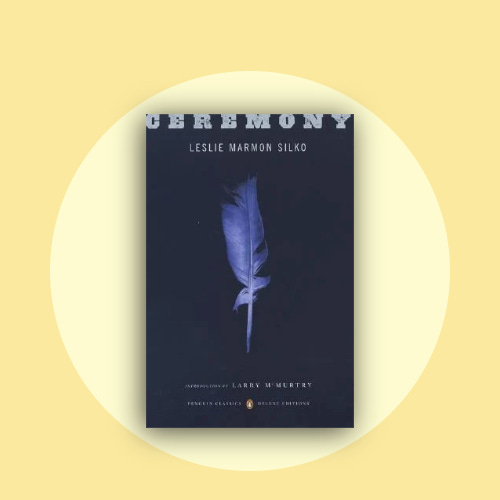
In Ceremony, Tayo returns to the Pueblo reservation where he grew up after serving in WWII, grieving the loss of his cousin who fought alongside him. Only about 250 pages long, the book is a beautiful meditation on identity, loss, and reclaiming your heritage. On top of that, it was also one of the first novels to show what PTSD is really like and has become a key work in the Native American Renaissance. No wonder it made Silko a MacArthur Genius.


Life is all about balance, which is why I’m currently toggling between the new season of Traitors, naturally, and also Ken Burns’ The American Revolution, which goes so hard you wouldn’t believe.
I’ve been struck by a lot of details in the documentary, things American history classes just gloss over, but the main one is how George Washington promised men who signed up for the Continental Army that they could have land that belonged to Native Americans. The war was always a battle to expand across the continent, to grab power by any means necessary, to steal from the Indigenous people who lived here first—something that feels extra applicable to our current reality.



Definitely not a real turret.
Okay, I've been waiting to read this until I finished watching this season of Traitors! I've only seen this season and season 1, and it's so interesting comparing the two. I found that in this season there was so much more stereotyping going on (i.e. classifying each other as a Gamer, a Housewife, etc.) which really clouded the contestants' judgement. You're so right in that the stories you tell yourself can be so convincing yet so incorrect. I almost think having normies is better for limiting biases, so it will be interesting what next season is like.
P.S. I, too, am a normie who could never be a Traitor. It would give me FAR too much anxiety lol
I am, and always will be, faithful to the UK versions of Traitors.
Good read and good reminder that stories have power, whether in our own head, in a game, or out in the real world. I am also working my way thru The American Revolution...it's certainly not the "romantic" version of events we were taught!